
Thousands of small charities and non-profits are making a huge difference in communities every day. They are often closest to the issues, able to respond quickly, and deeply connected to the people they support.
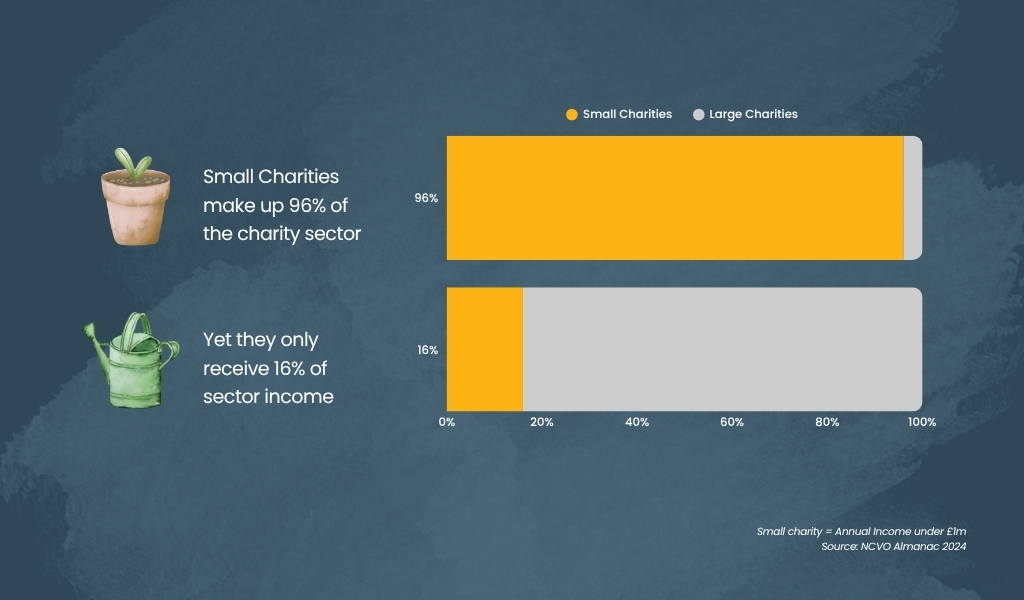
Yet despite this, they remain significantly underfunded. Small charities (those with an income of less than £1m) make up 96% of the sector but receive just 16% of its total income, according to the NCVO Civil Society Almanac 2024. And the gap isn’t just about money.
The challenge behind the challenge
For many small charities, the biggest barrier isn’t just funding. It’s the type of funding available. Unrestricted funding, which supports core costs like staff, systems, and infrastructure, is often the hardest to secure. Yet these are the foundations that enable organisations to deliver and grow their impact over time.
Project-based grants can be useful, but they don’t build the operational capacity that small charities actually need to grow. Many funders want to see money tied to specific activities or outputs, which inadvertently disadvantages the organisations least able to demonstrate impact in formal terms. Not because the impact isn’t there, but because they haven’t yet had the support to capture it.
The visibility gap
Many small charities lack the time, resource or expertise to communicate their work effectively. When organisations are focused on delivering front-line services, telling their story inevitably becomes a lower priority. As a result, high-impact work can go unseen, limiting opportunities to secure funding, build partnerships, and reach new audiences.
Through reviewing hundreds of applications each quarter, we see this consistently. The charities doing the most remarkable work are often the least visible. Not because their impact is small, but because communicating it takes capacity they don’t have.
This creates a cycle that’s difficult to break. Limited visibility means fewer funding opportunities. Fewer opportunities mean less capacity. And less capacity makes it harder to communicate impact, keeping organisations stuck at the same scale, year after year.
What small charities actually need
If small charities are to grow sustainably, they need more than financial support. They need:
- Flexible, unrestricted funding
- Simple and accessible application processes
- Support to communicate their impact clearly
Because while funding enables delivery, it is visibility that enables growth.
Small charities and ESG strategy: the missing piece
Many businesses want to make a meaningful difference, but face barriers in finding credible, high-impact charities to support. At the same time, small charities often struggle to access those opportunities. The gap between business intent and grassroots impact is real.
Businesses that bridge it effectively tend to go beyond the grant. The most meaningful partnerships combine financial support with employee involvement, clear visibility into impact, and a genuine connection to causes that matter to people. That approach doesn’t just benefit charities. It strengthens employee engagement and gives ESG strategy real substance.
Supporting small charities well means thinking about funding, expertise, and storytelling together. Because the organisations with the most to offer are often the hardest to find.
Grants for Good
The Grants for Good programme was built around these principles. It offers unrestricted grants of between £2,000 and £5,000 to UK-based charities and community groups with annual incomes below £50,000 – organisations typically overlooked by larger funders.
The programme receives up to 900 applications per quarter, giving us a detailed view of the grassroots charity landscape: the gaps in provision, the emerging needs, and the extraordinary work being done with very little. For businesses partnering with the programme, 100% of funding reaches these organisations directly, with no fees or administration costs.
To explore partnership opportunities, contact Kathryn Biggin, Strategic Partnerships Manager at the Matthew Good Foundation.